Stickletics
The Philosophy
Align & strengthen with a stick
We were built to move — to reach, twist, bend, brace and carry. Modern life quietly takes that away. We sit more, move less, and slowly lose the range and control our bodies were designed for. Stickletics exists to give it back.
At its heart, Stickletics is a simple idea: a plain training stick, placed in your hands, becomes a teacher. It shows you where you're tight, where you're unstable, and where your body has stopped talking to itself. Then it helps you put those connections back together — one deliberate, guided movement at a time.
What We Believe
Stickletics rests on a small set of convictions that shape every flow, every class, and every exercise.
Balance before intensity.
A body that moves well is worth more than a body that only moves hard. We build mobility, stability and control first — strength that lasts is built on top of alignment, not in spite of it.
The whole body is one system.
Muscles and joints don't work in isolation. Real function comes from integration — teaching the parts to cooperate — not from training them apart.
Simple tools, done well, outlast complicated ones.
You don't need a machine for every muscle. One stick, used with intention, can restore movement, sharpen awareness and challenge the whole body.
Science is the foundation, not the decoration.
Every sequence is grounded in how the body actually works — how it stretches, stabilizes and produces force. This isn't a trend; it's a method.
Movement should be for everyone.
From someone recovering an injury to an athlete chasing precision, the same principles apply — only the depth changes.

The Three Movements of the Method
Three connected stages — a single arc, moving from freedom to control to strength.
Regain mobility
Everything starts with range. Using the stick for leverage and guidance, we restore the natural motion the body has lost — safely opening the shoulders, spine and hips. The stick gives you something to reach into and stretch against, so you can go deeper without forcing.
Improve stability
Freedom without control is fragile. Once range returns, we build the ability to own it. The stick becomes a point of reference for balance and a tool to activate the shoulders and core, teaching the body to hold steady through movement it once avoided.
Integrate movement
Finally, the parts come together. Full-body exercises connect muscle to joint and effort to alignment, building strength that transfers to real life and real sport. This is where mobility and stability become lasting performance and healthier joints.
The Five Roles of the Stick
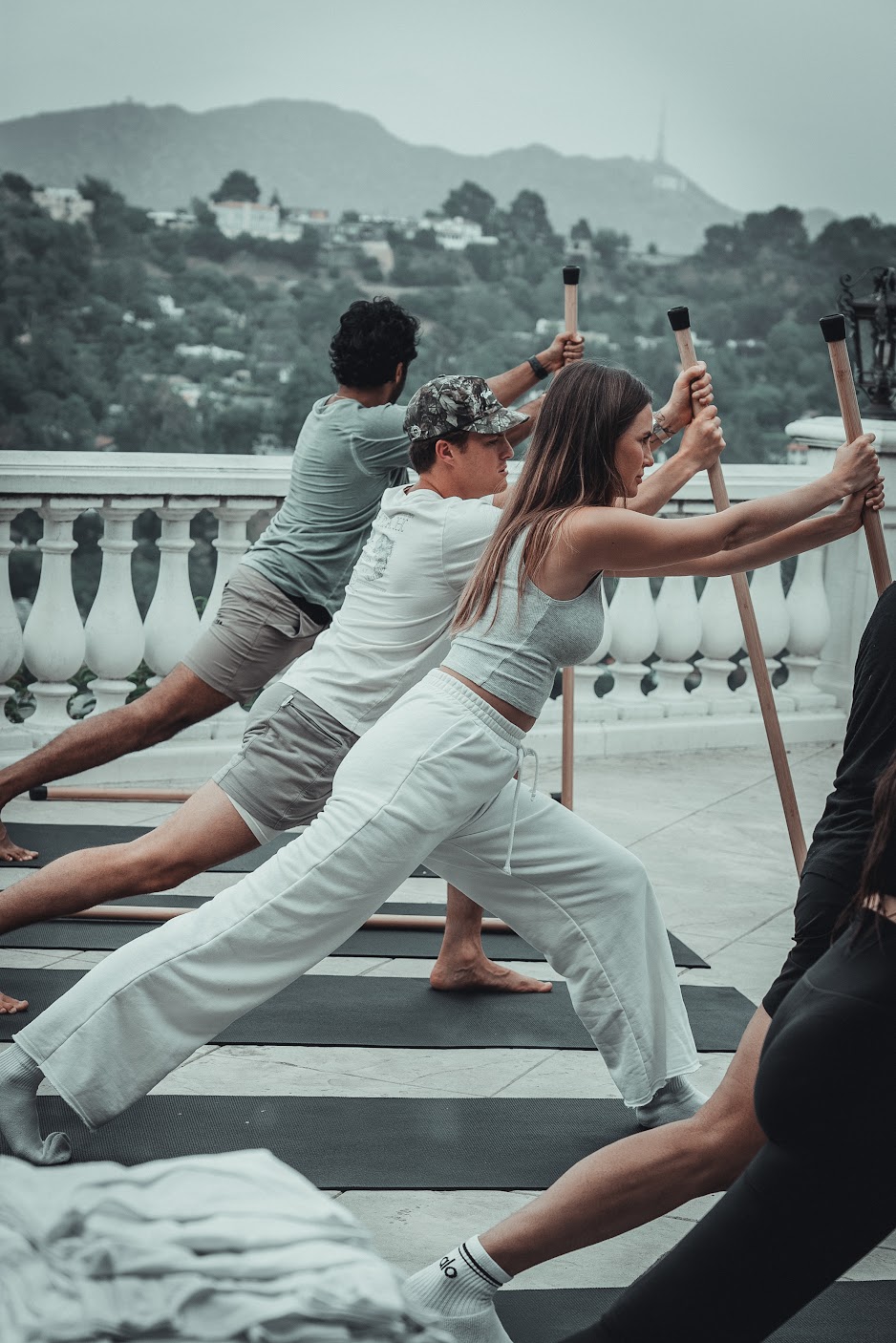
Inspired by yoga, Pilates, functional training and modern biomechanics, Stickletics centers on a simple training stick — it can be as ordinary as a broomstick. The stick is never decoration. It plays five distinct roles.

Orientation & posture control
The stick helps you sense your spine and pelvis more clearly in space. In forward bends, lunges or squats, it acts as a reference point, so you move only as far as your spine can stay neutral and controlled.
Stretch support
Actively pushing the stick away or pulling it apart creates length through the body. This improves joint centration, encourages an upright posture and can widen the range of a stretch.
Stability without propping
In lunge or single-leg positions the stick helps you hold your balance — while the real stabilizing work still comes from the trunk, pelvis and legs. It supports you without doing the job for you.
Activation & added resistance
Pulling the stick apart or pressing it together deliberately activates muscles in the shoulders and upper body. With the arms extended, leverage alone already creates a meaningful training load.
Relaxation & breathing support
A gentle pull or press makes the movement of the ribcage easier to feel and supports full, three-dimensional breathing, while pulling the stick apart can help release unnecessary tension in the neck and shoulders.
In short, the stick makes the invisible visible. It turns "try to stay aligned" into a felt, physical cue you can actually follow.
The Guiding Principles
Wholeness
The body is treated both as individual joints and regions and as one functional unit. Training moves deliberately from more isolated work toward integration into complex, full-body movement.
Body awareness
The feedback of the stick, together with breathing into different areas of the ribcage, sharpens how clearly you perceive your own body — a core prerequisite for lasting change.
Quality over intensity
Conscious, controlled movement matters more than speed or maximal effort. The goal is to refine movement patterns and make them more efficient — never to overwhelm the body.
Movement, not fixation
Stickletics builds active mobility and functional stability. The focus is on moving the body safely, under control, and efficiently through all three planes of motion.


How a Session Is Built
Every session follows the same arc — from waking the body up, to preparing it, to putting it back together in full-body movement.
Warm-up to prime the body for what follows.
Breathing exercises to connect breath to movement and center attention.
Mobility work to restore and explore range.
Activation to switch on the muscles that stabilize and control.
Integration into full-body positions, where the parts combine.
Dynamic patterns moving through all three planes of motion.
What Regular Practice Builds
Practiced consistently, Stickletics can help you:
- ✓
Improve joint mobility and reclaim range you may have lost.
- ✓
Carry a more conscious, upright posture through everyday life.
- ✓
Build functional strength and stability that transfers beyond the mat.
- ✓
Move more economically when walking, running or playing sport.
- ✓
Reduce your susceptibility to injury through better control.
- ✓
Release tension and raise the quality of your movement over the long term.

The Invitation
Stickletics is yoga, Pilates and functional training brought together around one honest tool. It asks you to slow down enough to feel your body clearly, and to rebuild it in the order it was meant to be built — mobile, then stable, then strong.
Pick up the stick. Rebalance your body.
— Developed by Ramin Waraghai, sports scientist
Get in touch